
Hon. Mal Bryce [ 1943-2018]
ELECTORAL REFORM ACT 1987
The extensive reforms made by the 1987 Act were the most significant in WA since self government in 1890.
Below a comparison between the electoral system which existed prior to 1987 and its replacement.
- At the 1986 election the National Party won 4 seats in the Legislative Council which gave them the balance of power.
- An agreement was thrashed out with the Nationals to pass the Bill in the LC guided by Nationals Leader there, Hon Ric Charlesworth. The National Party with members such as Hon Hendy Cowan and Hon Matt Stephens proved capable of reaching an agreement and sticking to it.
- The Natioinal Party would not accept the historic commitment of the ALP to a whole State electorate for the LC which meant this long standing objective had to be set aside.
- The choice faced by the Government was either to see the Bill fail or to accept amendments proposed by the National Party. The effect of the National Party amendments on representation in the LC was to create a system of regions and grant equal representation in the Legislative Council between 3 regions with 73% of electors in the metropolitan area and 3 regions with 27% of electors in the non-metropolitan area. Extreme cases of malapportionment ended among LA districts but a ratio of approximately 2:1 remained between metro and country districts.
- Minister with carriage of this legislation: Hon. Malcolm Bryce, Deputy Premier
- Thursday July 3rd 1986, First Reading formality (Hansard page 1300)
- Tuesday July 8th 1986 (pages 1428 -1435), Second Reading (sprinkled with interjections from Hassell, McKinnon and Rushton)
- Committee stages of the debate between (pages 2749-3046 Hansard 1986)
- Third Reading (Hansard pages 3660- 3664)
- Acts Amendment(ELECTORAL REFORM ACT) No 40 of 1987 was assented to on July 12th, 1987 and was proclaimed on Oct 30th, 1987
by the Hon. Mal Bryce, B.A., J.P., M.L.A.
Deputy Premier and Minister for Industry and
Technology; Defence Liaison, Communications;
Parliamentary and Electoral Reform
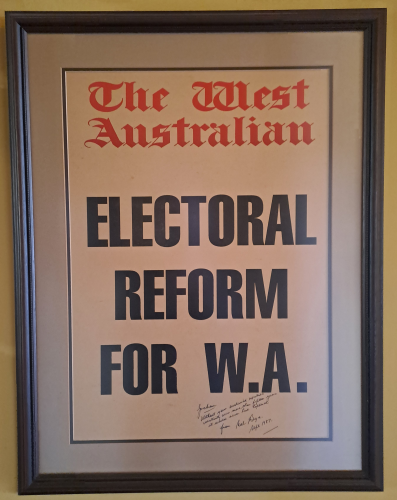
West Australian street banner Sept 1987
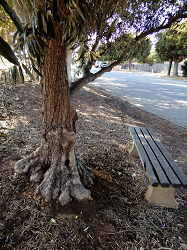
Tree of Democracy
an olive planted in Midland, Oct 1987
[apply at State election due in 1989]
- 3 years for MLAs.
- 6 years for MLCs.
MLCs previously avoided every second election
- 4 year terms
- Commencing with the 1989 election all Members of both Houses of Parliament are elected for 4 years.
- Terms for Members of the Legislative Council are fixed.
- A valid vote must number all candidates, 1,2,3,4, etc in the order of the voter's preference.
- No party names were printed on ballot papers.
- No change to full preferential voting, however;
simplified ticket voting is available on Legislative Council ballot papers. Placing the number "1" in a ticket voting square will register a ranked order of preferences for all candidates in accordance with a voting ticket which may be lodged by a candidate or group prior to the election. - Note: At the time "ticket vote marking" was accepted as a way to minimise informal votes on the much longer LC ballot papers required in multi-member regional elections. In time the ticket vote was corrupted by so called "Preference Whisperers" who were paid to arrange preference exchange deals among several micro parties to gather preferences at the tail end of the count and produce strange unacceptable results. Reform of the ticket vote system was included in the Electoral Equality Act of 2021.
- Candidates may have "Independent" or the name of their party or group printed alongside their names on all ballot papers.
- A redistribution did not occur unless 8 or more districts deviated by more than 20% from their enrolment quota at an election.
- A redistribution of electoral boundaries will occur automatically one year after every second election.
- Some electoral boundaries, for example the 4 districts in the North-West-Murchison-Eyre Area and the Metropolitan border were drawn by politicians.
- The statutory boundaries of Kimberley, Pilbara, Gascogne and Murchison-Eyre districts which were the subject of the most serious malapportionment and gerrymander in the State were abolished.
- Boundaries for all LA districts and LC regions will be drawn by independent Electoral Distribution Commissioners.
- Except:- The Act selects the Metropolitan Region Scheme boundary on 1st January 1987 as the boundary between the metropolitan area and the country.
- There was a State Electoral Department.
Many decisions were made by the Government of the day.
- A Western Australian Electoral Commission has been established. This Commission is a statutory body with guaranteed independence of operation and staffing. It is fully responsible for the impartial administration of the electoral law.
- District enrolments ranged from approximately 34,000 down to 4,000, a ratio of 8.5:1.
- On average:
Metro districts were 20,670 each.
Country districts were 10,714 each. - The ratio between average metro and country enrolment per Member was 1.93:1.
- Some progress towards equally valued votes.
- Extreme cases of inequality abolished.
- Approximate enrolments are:
34 metro districts of 19,685 and
23 country districts of 10,438.
- The ratio between average metro and country enrolment per Member is 1.88:1.
- Province enrolments ranged from approximately 99,700 down to 9,050, a ratio of 11:1.
- On average:
Metro MsLC represented 44,293 each.
Country MsLC represented 14,464 each. - The ratio between average metro and country enrolment per Member was 3:1.
- Some progress towards equally valued votes.
- Extreme cases of inequality abolshied.
- 17 Metro MsLC represent approximately 39,370 each.
17 Country MsLC represent approximately 14,120 each. - The ratio between average metro and country enrolment per Member is 2.79:1.
- Each province was represented by 2 MsLC, one elected at each election and the votes were counted by the preferential system.
- Vacancies were filled at a by-election.
- Members of the Legislative Council are elected from 3 metropolitan and 3 country regions.
At the multi-member elections in each region votes are counted by a system of proportional representation which guarantees an accurate match between votes and seats won. This is the system used for the Australian Senate. - Vacancies are filled by a re-count.
