This page outlines significant past electoral reforms for
Western Australia

Detail about 1987, 2005 & 2021 under Contents link


ELECTORAL EQUALITY ACT 2021

  • Minister Hon John Quigley appointed an expert panel to advise on reform after the ALP won the first ever majority in the LC at the 2021 elecction.
  • The State became a single electorate [ the whole of State electorate] to elect 37 members of the LC - one additional Member.
  • Each Member elected must receive a quota a fraction above 2.63%.
  • Far reaching reform to ticket vote marking, counting and to registration of political parties.
  • No change to LA arrangements.


ONE VOTE ONE VALUE ACT 2005

  • From the 2008 election, most voters in WA have voted in districts of equal enrolment for the LA, where the Government is formed.
  • Hon Jim McGinty as Minister gained the vote of an Independent [ formerly Liberal] Hon Alan Cadby, and together with the Greens, guided through this significant reform
  • Two districts were added to the LA to make 59 and two seats were added to the LC to make 36.
  • Six regions were retained but the number of MsLC in each changed to 6, 3 metro regions and 3 country regions.
  • The LC became less democratic, inequality actually increased and the boundary of the metropolitan area was retained . In order to achieve reform of representation in the LA the Government was forced to conform to Greens policy as their model of the LC was a condition of their support for reform.


1990

  • Dr Carmen Lawrence became the first female Premier in Western Australia.


ELECTORAL REFORM ACT 1987 and
Electoral (Procedures) Amendment Act

The extensive reforms made by the 1987 Acts were the most significant since self government in 1890. Hon Mal Bryce as Minister.
  • Adopted 4 year terms for both Houses and
  • proportional representation from 6 regions for the LC.
  • The defined metro area given 3 regions of 7, 5 & 5 and elsewhere three regions of 7, 5 & 5.
  • Created the independent WA Electoral Commission the role of which included drawing all electoral boundaries except that of the metro area which set up the inherit imbalance in representation.
  • Polls to close at 6pm instead of 8pm, party names possible on ballot papers, and other matters.
  • This Act ended gross inequalities in enrolments but continued inequality in both Houses by keeping the metropolitan area boundary.


ELECTORAL AMENDMENT ACT 1983

  • Created the co-operative enrolment agreement with the Commonwealth so that one application [instead of three] would achieve enrolment to vote in Commonwealth, State and Local Government elections.
  • Removed provisions which required enrolment applications to be witnessed by persons in authority like JPs.
  • Election timetable altered to enforce adequate notice of closure of the roll.
  • Australian citizenship became a primary qualification for enrolment.

ELECTORAL AMENDMENT ACT 1970

  • Age for enrolment and voting reduced from 21 to 18 years.
  • Position of names on the ballot paper to be decided by chance instead of alphabetically.

AUSTRALIAN CONSTITUTIONAL REFERENDUM 1967

  • Uniform rights to vote gained for Aboriginal people.

ELECTORAL ACT AMENDMENT 1964

  • Qualifications to enrol and vote in Legislative Council elections made identical to those for the Legislative Assembly. This abolished plural voting and property qualifications which had previously existed for the Legislative Council.
  • Compulsory enrolment and voting introduced for Legislative Council elections to match what already existed for the Legislative Assembly.
  • Differential election time schedules for various areas within the State abolished.

1962

  • Spouses of house holders became eligible to vote
  • Aboriginial people over 21 became eligible to vote.

1954

  • Hon Ruby Hutchison [ALP] became the first woman to be elected to the Legislative Council.

1920

  • Women became eligible to stand as candidates for election to either House of Parliament. Mrs Edith Cowan became the first woman to be elected to an Australian Parliament in 1921.

ELECTORAL ACT 1907

  • Only one vote per person now allowed in Legislative Assembly elections.
  • Property qualifications to vote in Legislative Assembly elections were removed.

1899

  • Women over 21 gained the right to vote in Legislative Assembly elections.

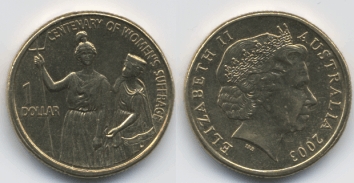
  • Four years later this reform occurred in time for the 1903 Commonwealth elections and this was the first time in the world that women could both vote and stand for election to a national parliament.
Commemorative coin for the 2003 centenary of women's suffrage for Commonwealth elections

Commemorative coin for the 2003 centenary of women's suffrage for Commonwealth elections

1893

  • The first fully elected Legislative Council. One third of Members were previously appointed by the Governor.

1890

  • In 1889 the Parliament was expanded into two Houses, adding the Legislative Assembly.
  • The Legislative Council reverted to a House of appointed Members until 1893.
  • At the first Legislative Assembly election in 1890 no females or Aborigines could vote or be a candidate.
  • Men had to own property in order to vote and be a candidate and if property was owned in several electorates that made plural voting possible.

1870

  • The previously appointed Legislative Council became composed of 6 appointed and 12 elected Members.
  • Only heads of house holds and property owners were able to vote. [The qualifications to vote were for males over 21 years who owned freehold property valued at a minimum of £100 or paid an annual rent of £10. That is approximately 3,000 out of 15,000 non-indigenous males.]
  • Plural voting was permitted for those who owned property in several electorates.

1832 to 1870

  • The Governor appointed Members to the small Legislative Council. There were no elected Members.


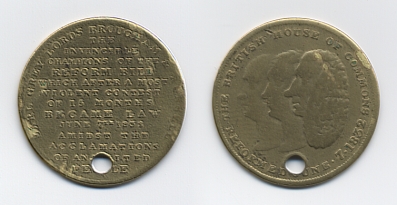
Tails
EARL GREY LORDS BROUGHAM & RUSSELL
THE INVINCIBLE
CHAMPIONS OF THE
REFORM BILL
WHICH AFTER A MOST
VIOLENT CONTEST
BECAME LAW JUNE 7TH 1832
AMIDST THE
ACCLAMATIONS
OF AN UNITED PEOPLE
Medallion struck to commemorate passing of the historic Reform Bill in England in 1832 Heads
THE BRITISH HOUSE OF COMMONS
REFORMED JUNE 7 1832

An important historical step towards democracy was taken after a long and bitter struggle when the English Parliament passed the Great Reform Act in 1832.


Return to the top of this page. Built using HTML-Kit Hosted by  
Web page created by Graham Hawkes.